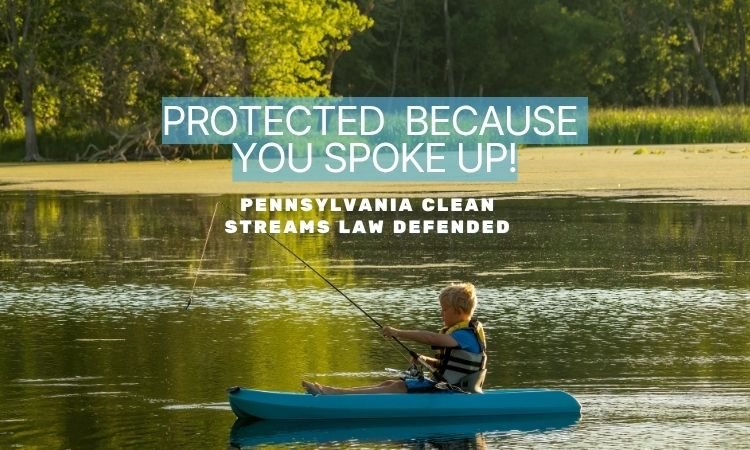
Pennsylvania’s Clean Streams Law (Act 394 of 1937) safeguards waterways that provide drinking water to millions of residents. These waters also sustain a thriving outdoor recreation economy, supporting more than 168,000 jobs and generating $9 billion in annual wages, according to the U.S. Bureau of Economic Analysis.
That’s why Clean Water Action, with strong support from its members, worked to defend this cornerstone environmental law against a proposed rule by the Pennsylvania Department of Environmental Protection (DEP). The proposal, “Notification Requirements for Unauthorized Discharges to Waters of the Commonwealth” (25 Pa. Code Chapter 91), would have significantly weakened protections for both surface and groundwater. It risked reducing public awareness of pollution incidents, slowing agency response times, and delaying critical cleanup efforts.
Current regulations in 25 Pa. Code Chapter 91.33 require any individual or company that spills a “toxic substance or another substance which would endanger downstream users of the waters of this Commonwealth, would otherwise result in pollution or create a danger of pollution of the waters, or would damage property, is discharged into these waters—including sewers, drains, ditches or other channels of conveyance into the waters—or is placed so that it might discharge, flow, be washed or fall into them” to notify DEP of the spill.
The proposed rulemaking would’ve changed it so that polluters have broader discretion in determining whether DEP should be notified of a spill that falls outside of a federal list of reportable quantities for specific hazardous substances or if that spill has the potential to impact a waterway.
In that broader discretion was also flexibility to only have to satisfy one of twelve identifying factors. Some of the factors were flimsy, like “proximity to nearby waters of the Commonwealth” without any clarification of what an appropriate minimal distance is or allowing industry to play meteorology through forecasting weather conditions before, during and after the unauthorized discharge. In a practical sense—it raised questions about whether companies really have the time during a crisis incident to accurately figure out the metrics to meet some of the factors and trigger the avoidance of having to report a spill. These lapsed reporting requirements created ambiguity not clarity, confusion for the public, and real concerns for our environment.
To make matters worse, the proposed policy change has long been primarily advocated for by Merck Sharp & Dohme Corporation, a multinational pharmaceutical company because they were unhappy with a 2017 settlement with DEP over an appeal of a stormwater pollution prevention permit for its West Point, Montgomery County plant. The Merck Sharp & Dohme Corporation is a company that has also racked up roughly $5.3 million in penalties from DEP for environmental violations from 2000-2016. Given this abysmal track record, it’s no wonder they want softer regulations. Plus, they needed to attempt to go this route after the legislation of a similar nature that they tried to push failed to pass the General Assembly in multiple sessions- receiving steep opposition from sportsmen, environmental, county conservation districts and many other groups.
The national perspective provided added context to the landscape surrounding this issue. The Trump Administration, during their first term, dismantled nearly 100 policies focused on clean air, water, wildlife and toxic chemicals. During the early days of their return to Washington D.C. for a second term they re-escalated their assault on clean water protections through executive actions, launching historic deregulation actions, and announcing major cuts to agency budgets and workforces.
Given these circumstances, now was not the time for Pennsylvania to pursue changes that give industry greater leeway when it comes to protecting our waterways. In fact, Pennsylvanians are actually relying even more on our state officials and agencies to fill in the voids being left by national environmental policies.
Fortunately, public engagement made a difference. Clean Water Action mobilized residents across Pennsylvania during the 60-day public comment period in spring 2025, ensuring strong opposition was heard. In response, DEP announced one year later that it would WITHDRAW the proposed rulemaking!
This victory sends a clear message: Pennsylvanians value clean water and strong protections. While it represents a significant setback for corporate efforts to weaken environmental safeguards, it is, more importantly, a win for public health, local economies, and the future of the Commonwealth’s waterways. It also demonstrates the power of collective action in defending the resources communities depend on every day.


